POLKA
















Multi-LiDAR fusion node for ROS 2. Takes any mix of PointCloud2 and LaserScan sources and publishes one merged PointCloud2, one merged LaserScan, or both. Filters per source and on the output, deskews with IMU and odometry, and uses CUDA if you build it in. One node instead of a relay, filter, transform, merge and downsample chain.
Features in action
Each clip is polka with a different config, run on the TIERS multi-LiDAR dataset (Ouster OS1 + Livox Avia + Mid-360) and rendered headless with Open3D. media/ has the scripts to regenerate them.
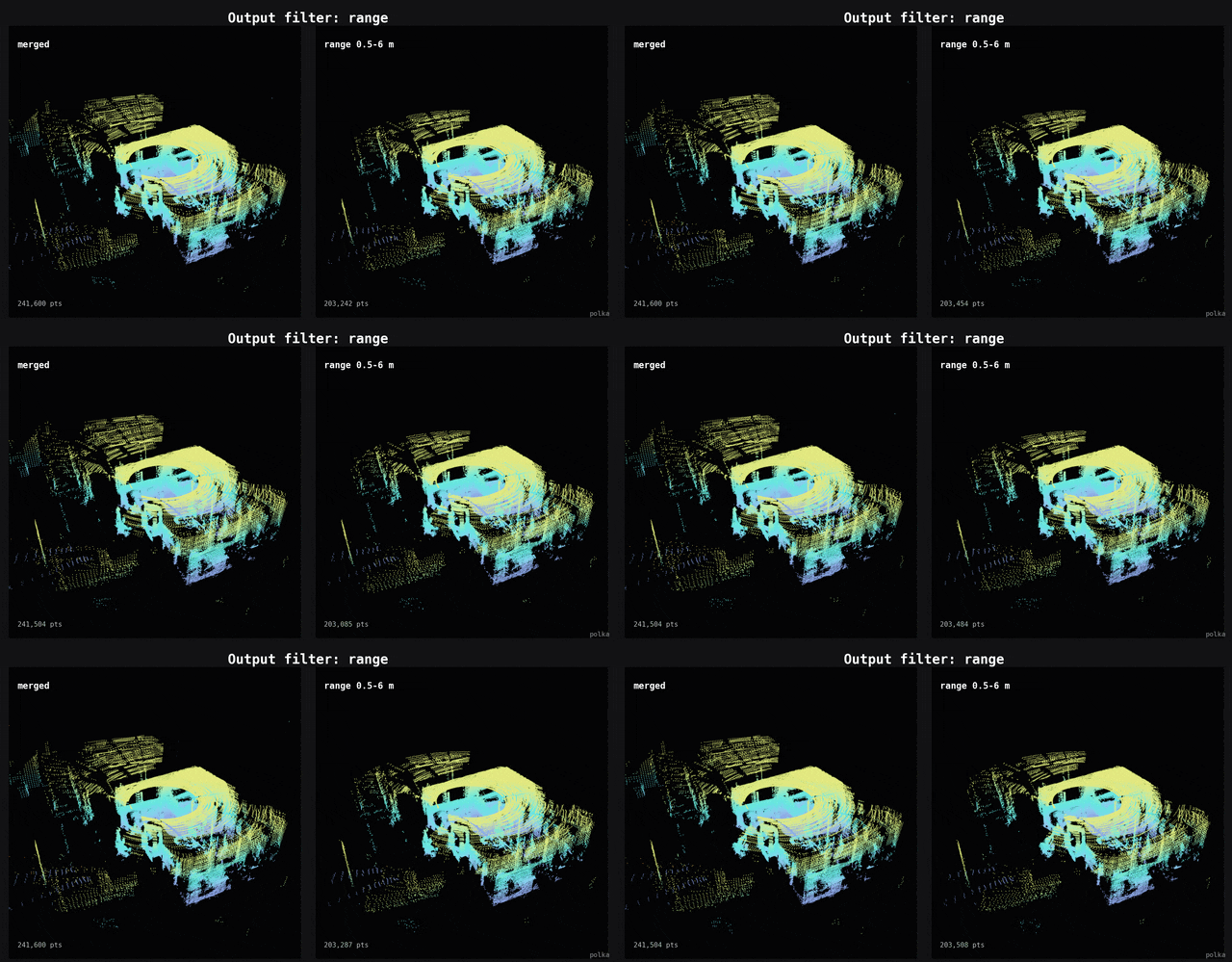 Range filter: keep points within a distance shell |
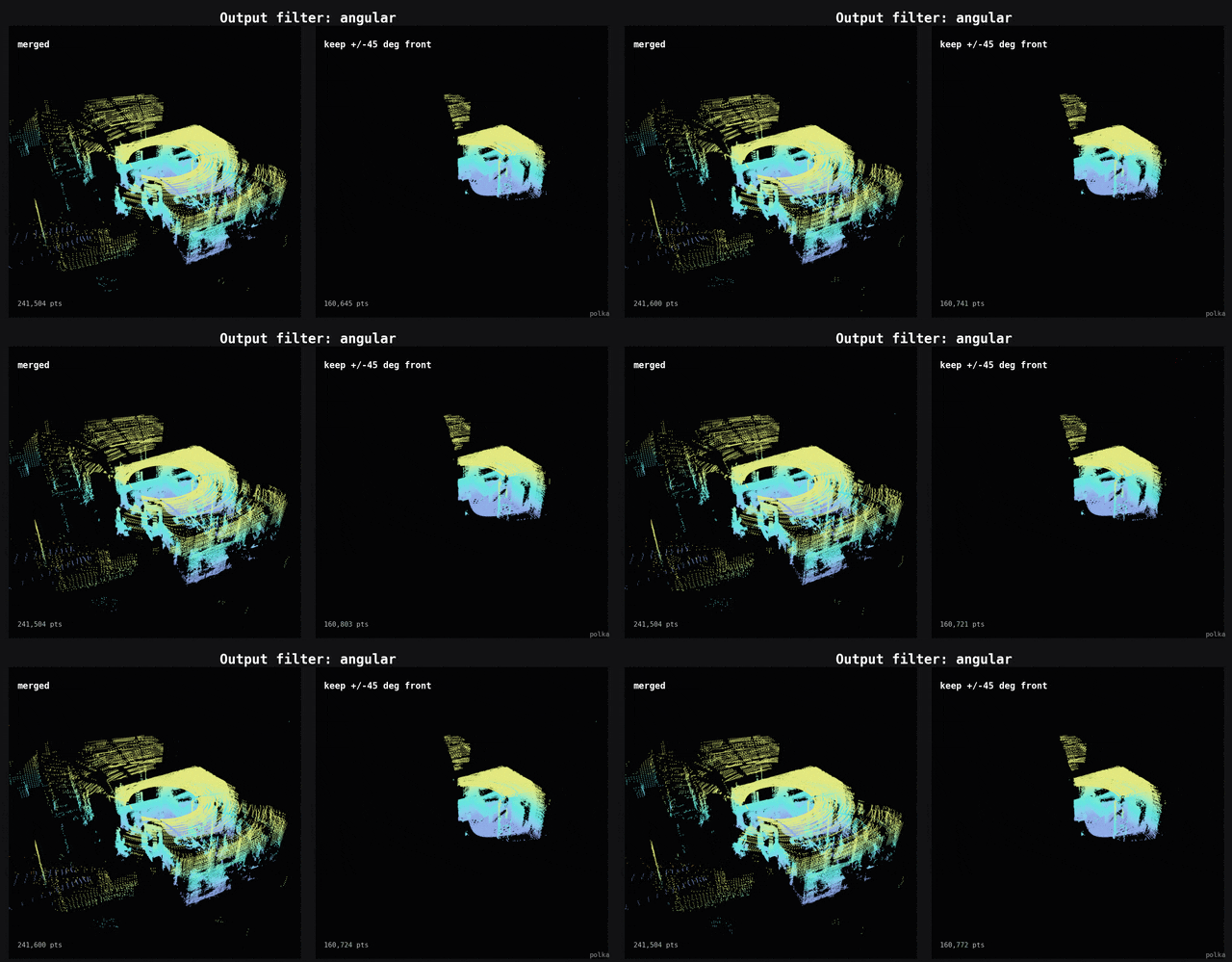 Angular filter: keep a yaw sector |
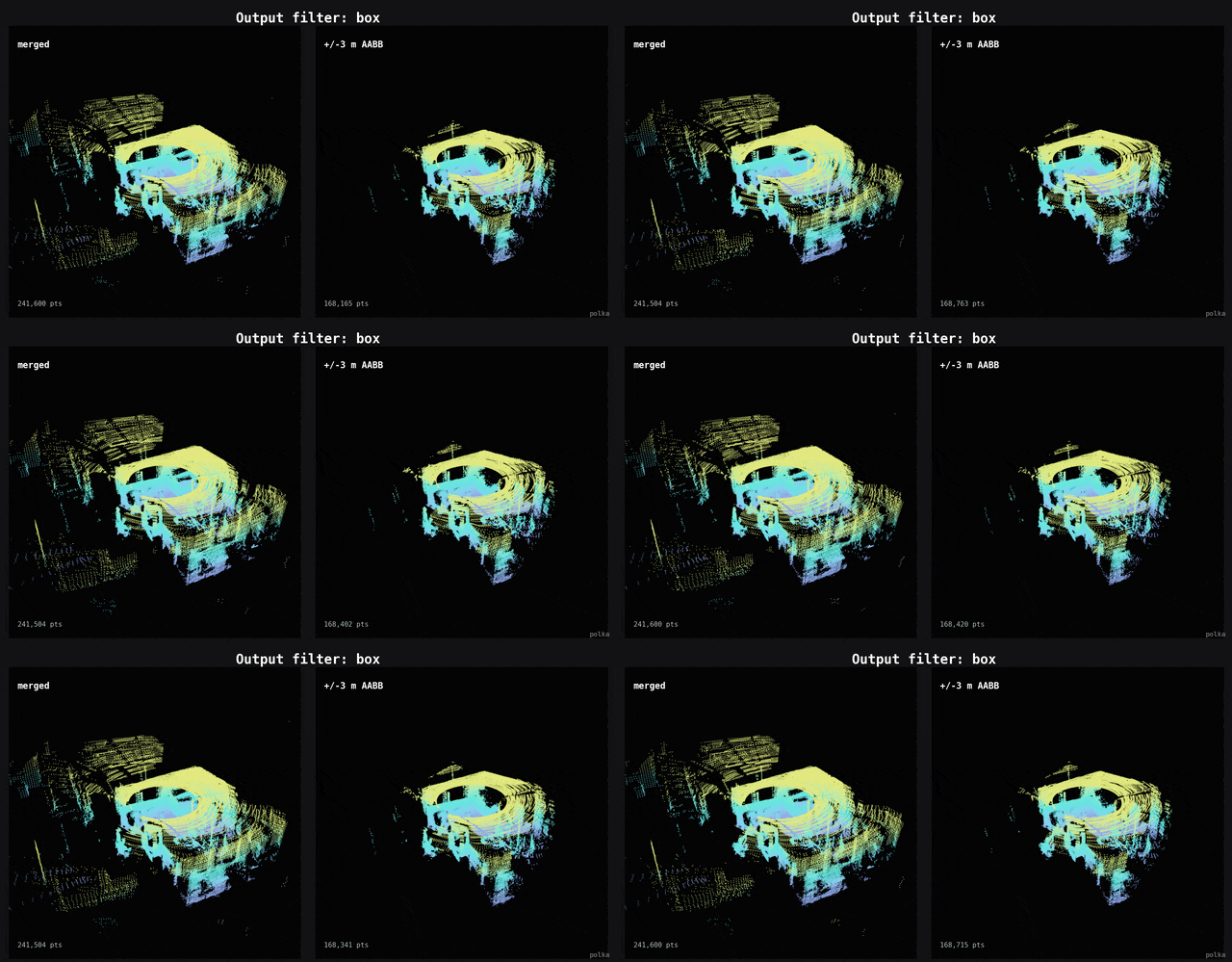 Box filter: crop to an axis-aligned box |
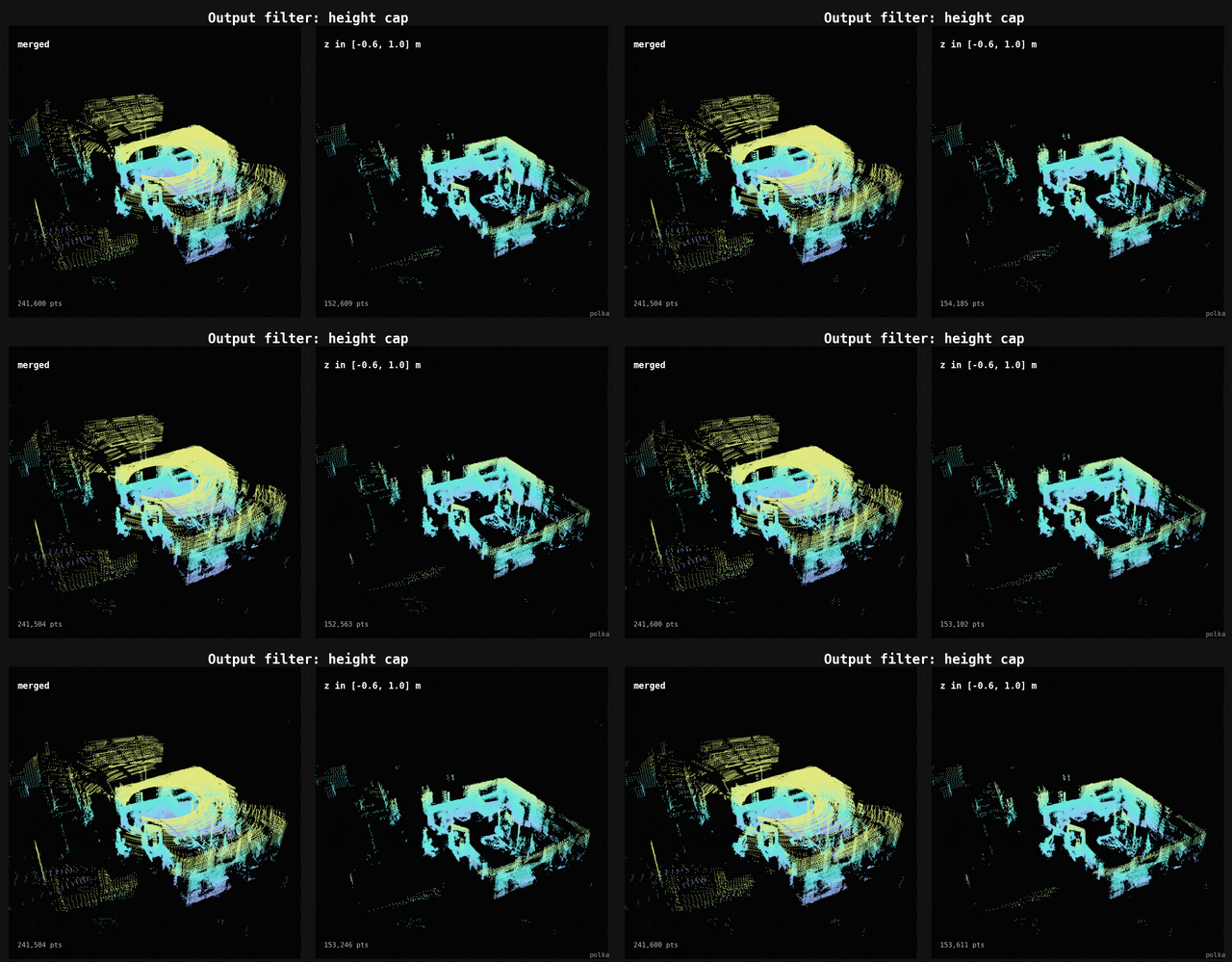 Height cap: clip to a z-range |
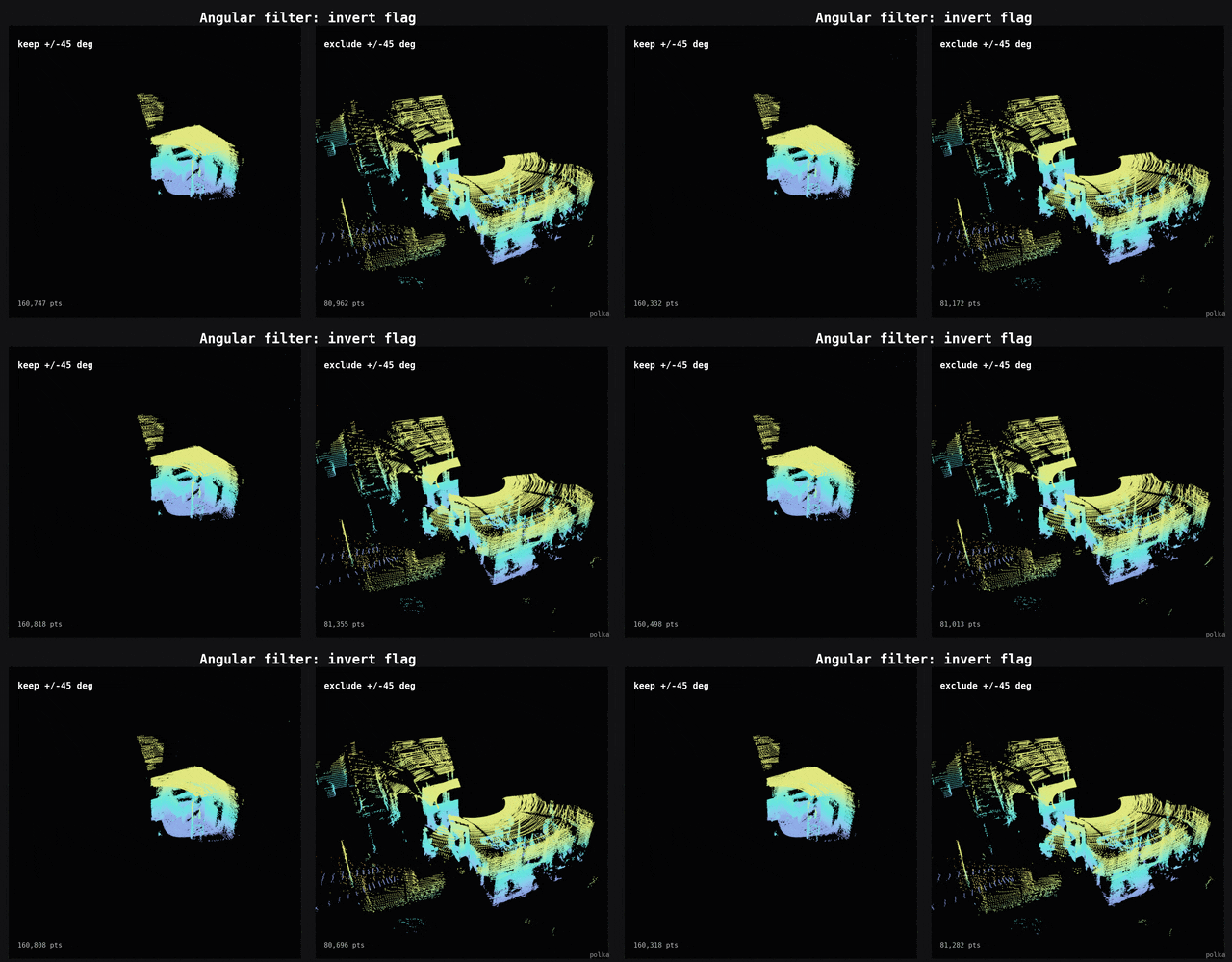 Angular invert flag: keep vs. exclude a sector |
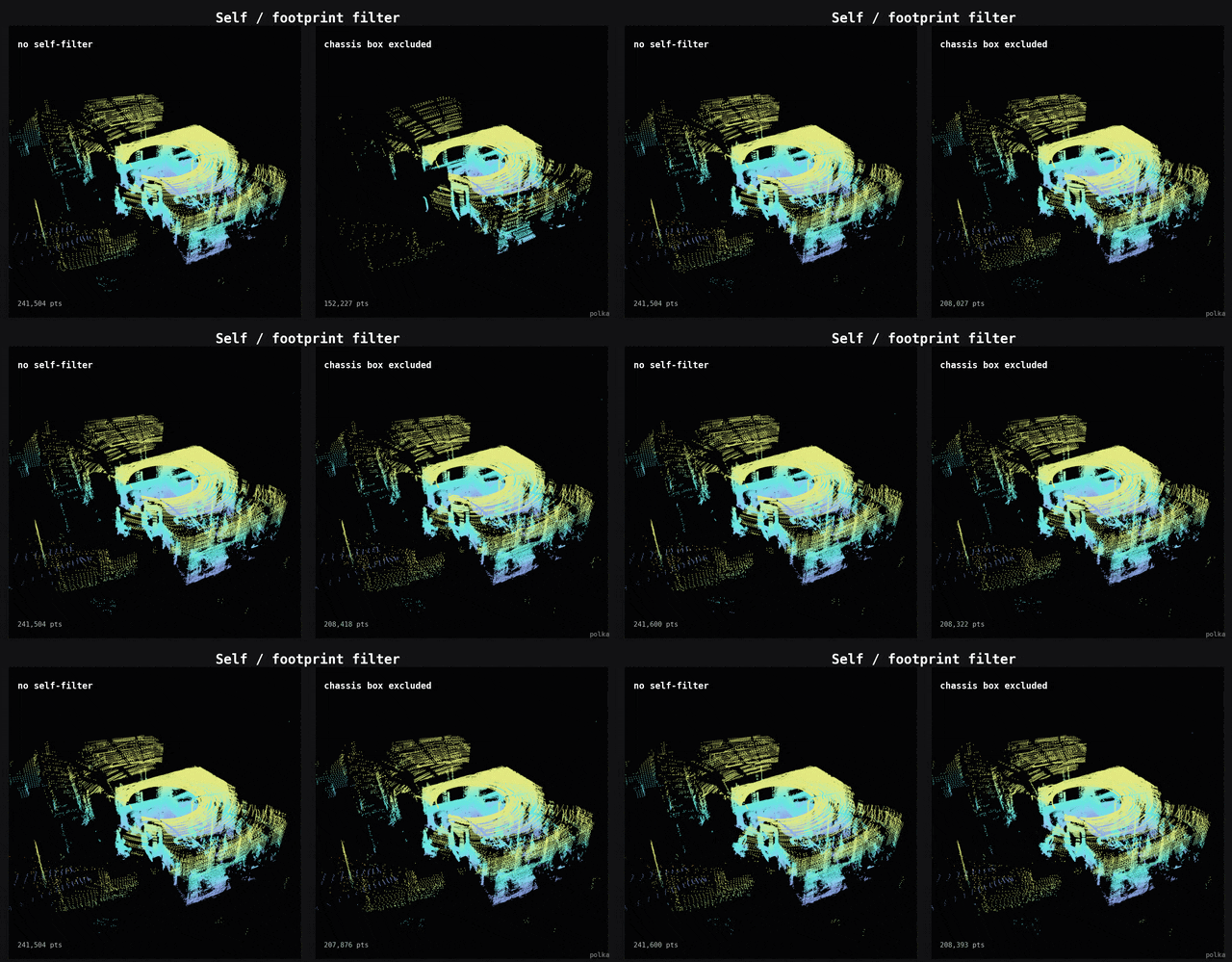 Self-filter: remove the robot's own footprint |
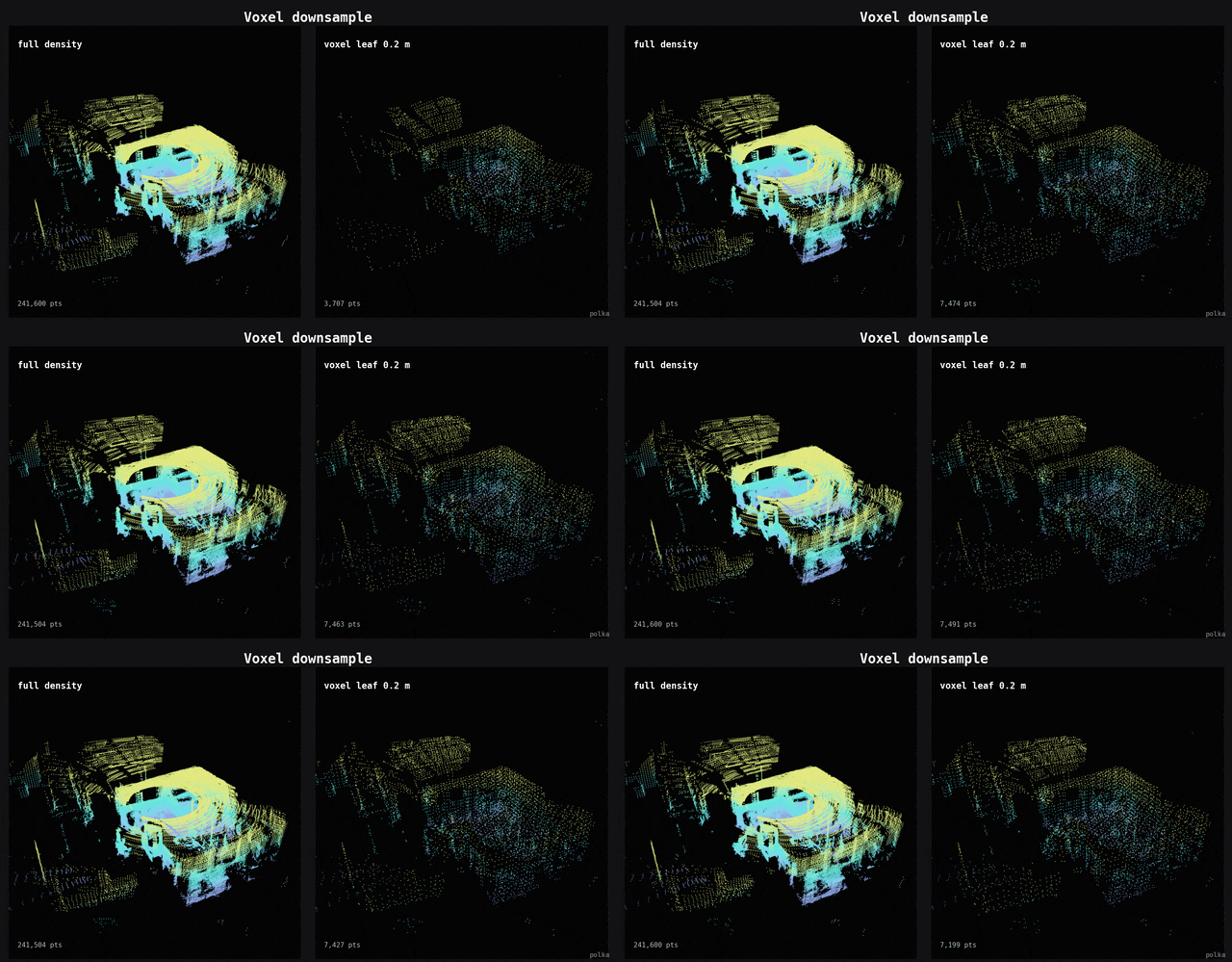 Voxel downsample: 69k to 5k points |
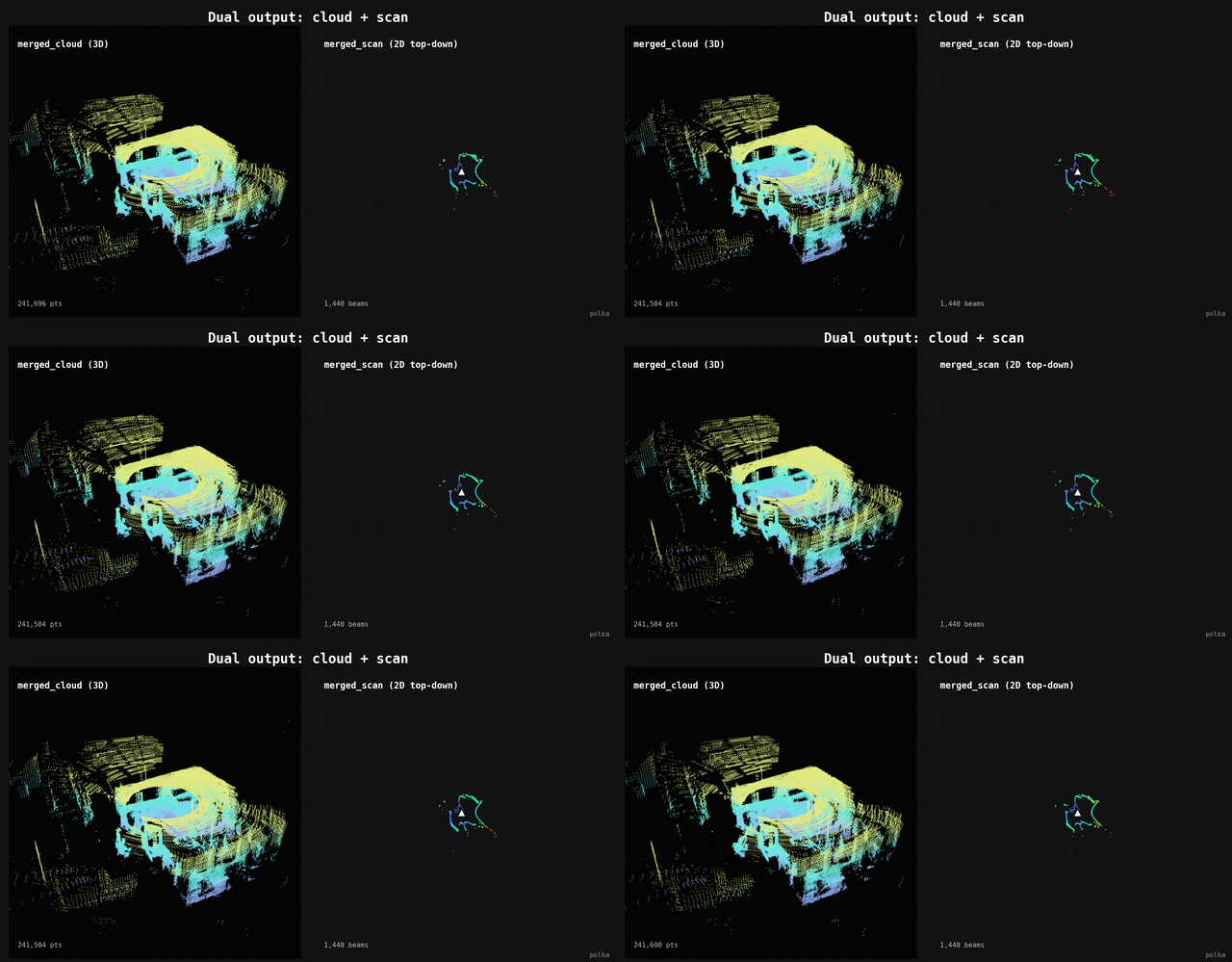 Dual output: merged cloud plus flattened 2D scan |
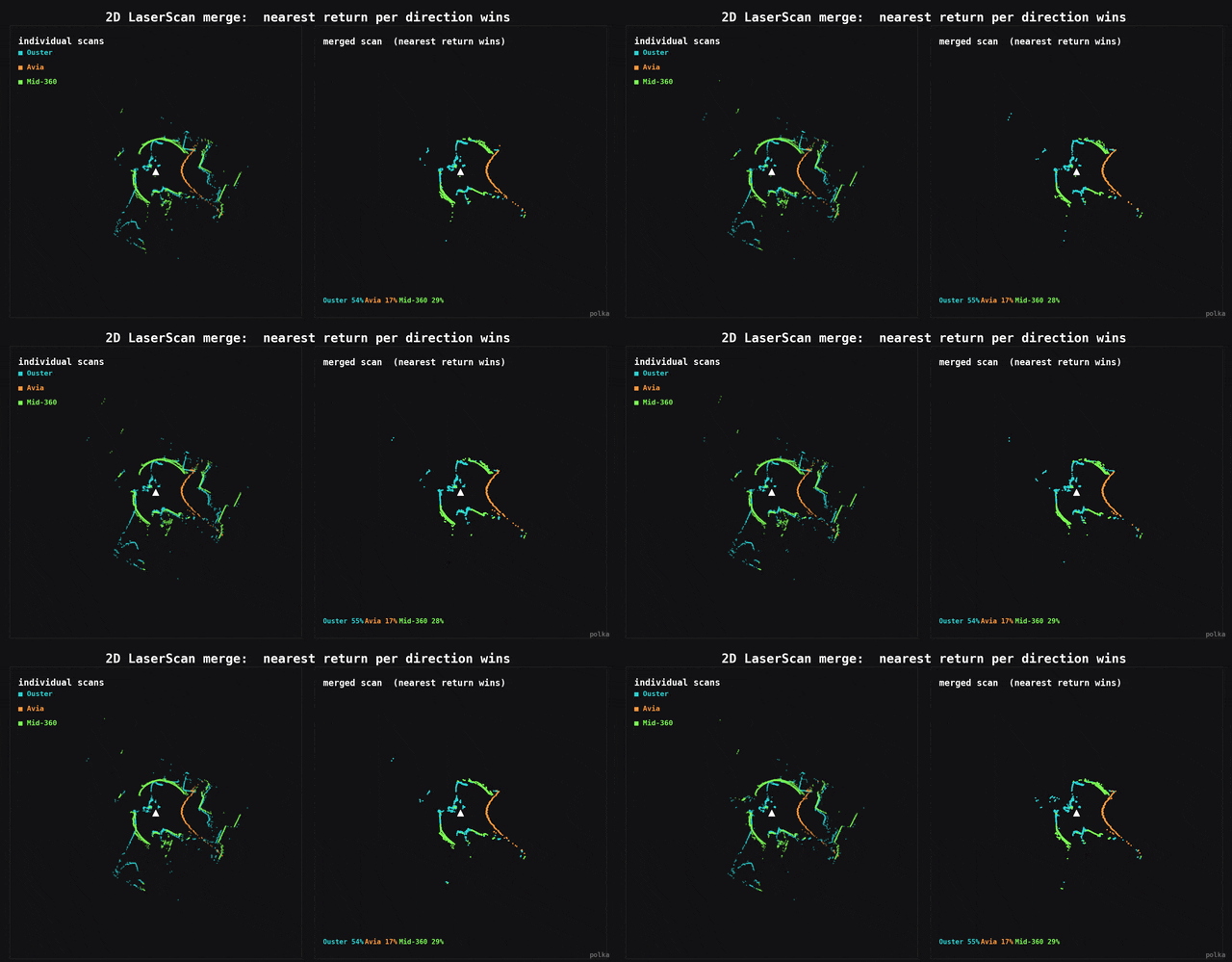 2D LaserScan merge: each beam colored by the sensor with the nearest return |
|

Simulated: three lidars on the articulated rig from #2, geometry from its bag's TF. Each sweep is deskewed with IMU, odometry and steering-joint rate, filtered per source, merged and filtered again.
Performance
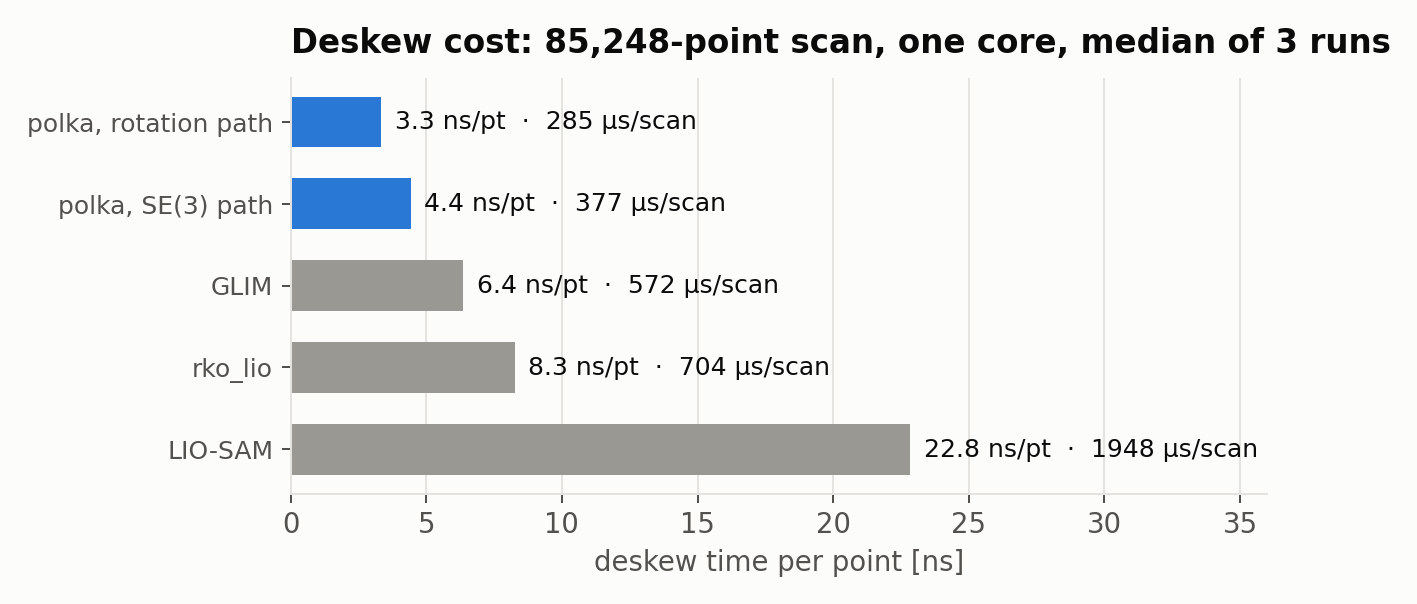
Deskew. 3.3 ns per point rotation-only, 4.4 with translation: 1.5 to 7x cheaper than the deskew step of GLIM, rko_lio and LIO-SAM on the same public clouds. Method and versions in Performance.
CUDA. The GPU merge engine does transform, filter, voxel and scan flatten in one pass over the points, which pays off on heavy pipelines. On a filterless merge the CPU stays competitive — there is not enough per-point work to hide the kernel dispatch and the host-to-device copy. The apt packages include it, and it falls back to CPU on its own. It is not faster everywhere. The packages from the polka apt repository have the GPU engine built in. Packages from the ROS build farm will be CPU-only: it has no CUDA toolchain.
Bandwidth. polka turns N sensor streams into one topic, so downstream nodes subscribe once instead of once per sensor. Voxel downsampling thins that cloud further if you want it, by as much as you set with leaf_size — in the demo clip 69k points become 5k, but that is one leaf size, not a fixed ratio or a 0.5.0 speedup.
Performance notes covers where the numbers come from and when CUDA stops paying off.
Features
- Heterogeneous fusion: mix 3D PointCloud2 and 2D LaserScan sources freely
- Dual output: merged PointCloud2, LaserScan, or both at once
- Per-source and output filtering: range, angular, box, height cap, footprint (ego-body) exclusion, voxel downsample
- Deskewing: per-point SE(3) motion correction, cost independent of point order; translation from odometry, IMU, or none; gyro bias learned at standstill; per-point timestamp auto-detect
- CUDA acceleration: optional GPU merge engine, falls back to CPU
- TF2 integration: automatic lookup with last-known-good fallback
- Runtime reconfiguration: filters, outputs, deskewing and the source list all change live via
ros2 param set, no restart - Diagnostics and a terminal dashboard: per-source rate, bandwidth and lag on
/diagnostics, drift flags, and an optionalpolka_monitorTUI - Composable node: runs standalone or in a component container
Sensor and IMU support
| Capability | Supported | How |
|---|---|---|
| 3D PointCloud2 | yes | native |
| 2D LaserScan | yes | projected and merged |
| Single global IMU | yes | motion_compensation.imu_topic |
| Multiple IMUs (per source) | yes | sources.<name>.imu_topic |
| Decentralized IMUs (different mounts) | yes | TF rotates angular velocity and acceleration into each sensor frame |
| External IMU per lidar | yes | any sensor_msgs/Imu frame with a TF to the lidar |
| Articulated IMUs (moving joint or turret) | yes | dynamic TF from joint_states; config/example_articulated_imu.yaml |
| Velocity from odometry | yes | motion_compensation.translation: odometry, lever arm and joint rate from TF |
Every source can have its own IMU on its own mount. polka looks up the live TF from each IMU frame to its sensor frame and rotates that IMU's angular velocity and acceleration into the sensor frame before deskewing, so a fixed chassis LiDAR and a rotating turret LiDAR each deskew against the motion they actually see:
graph LR
  gimu[global IMU] -->|TF into sensor frame| chassis[chassis LiDAR]
  timu[turret IMU] -->|TF into sensor frame| turret[turret LiDAR]
  chassis --> polka
  turret --> polka
polka --> merged[one merged cloud]Translation
An IMU gives rotation and changes in speed, not speed itself, so steady motion leaves skew behind. translation: odometry takes velocity from any nav_msgs/Odometry (wheels, an EKF, GNSS), moved to each lidar's origin through TF. That source must be independent of the clouds being deskewed.
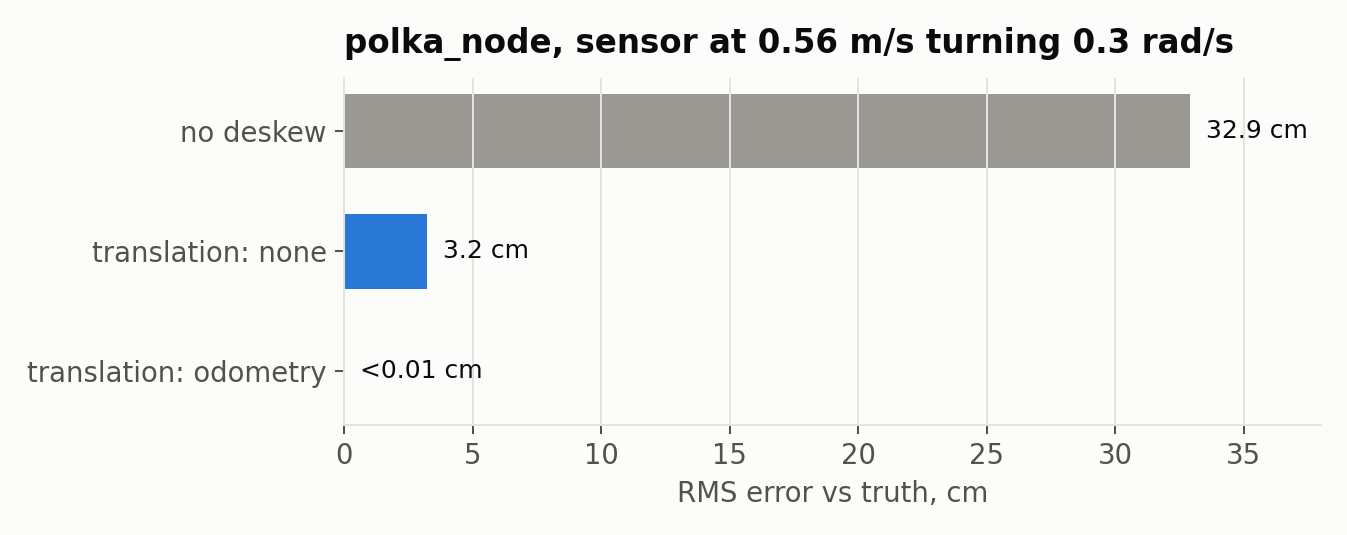
polka_node on a synthetic stream with exact truth.
Articulated vehicles
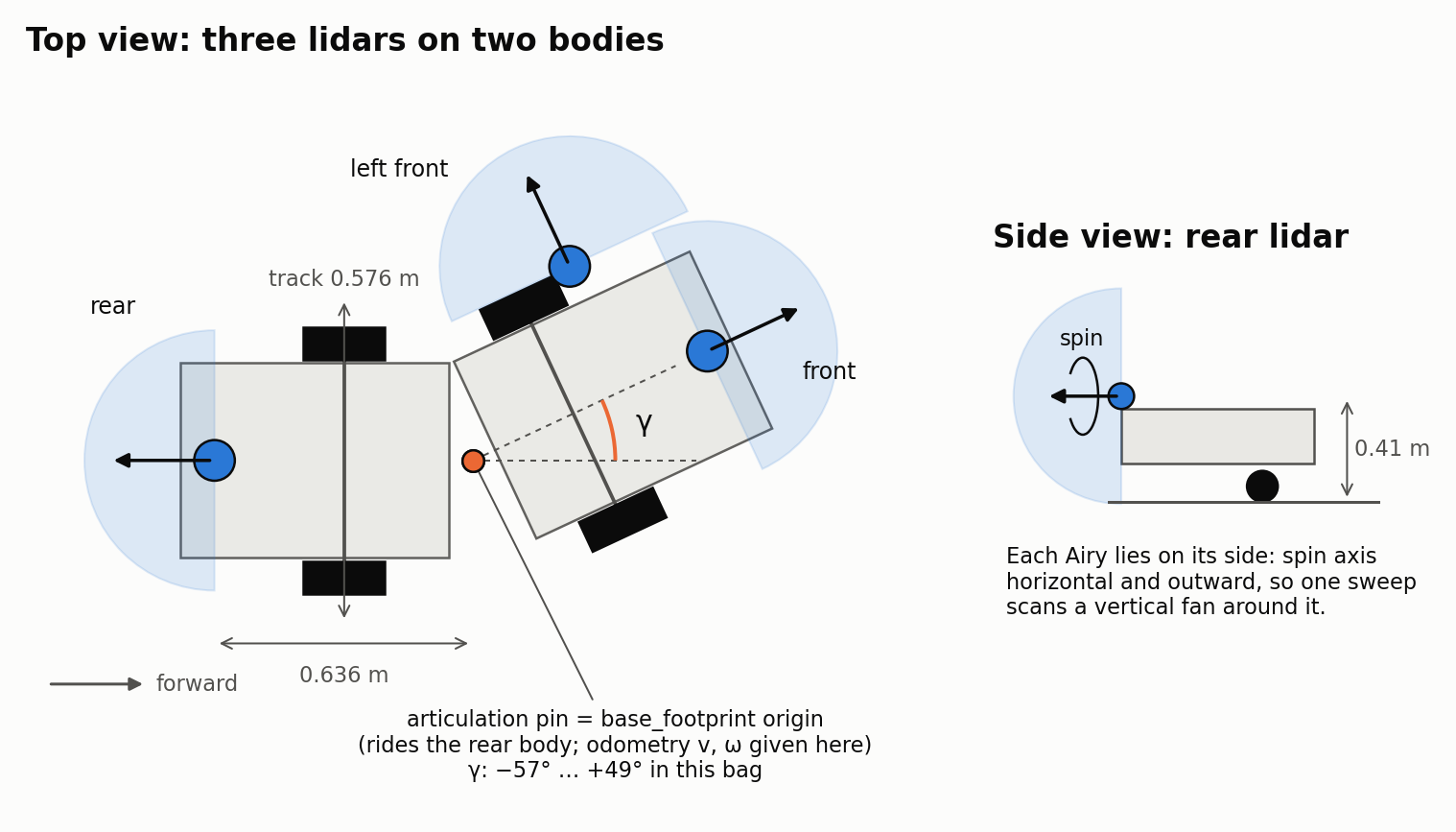
The rig from #2 as read from its bag's TF. Positions measured, body outlines schematic.
Odometry reports the rear body; the front lidars ride the steering joint. polka adds each lidar's rate relative to the odometry frame, sampled from TF over the scan, and places every cloud with its mount pose at its own stamp. On the real front-lidar scan in test/data that takes the lidar's speed from 0.61 to 0.46 m/s and removes 6 cm of error.
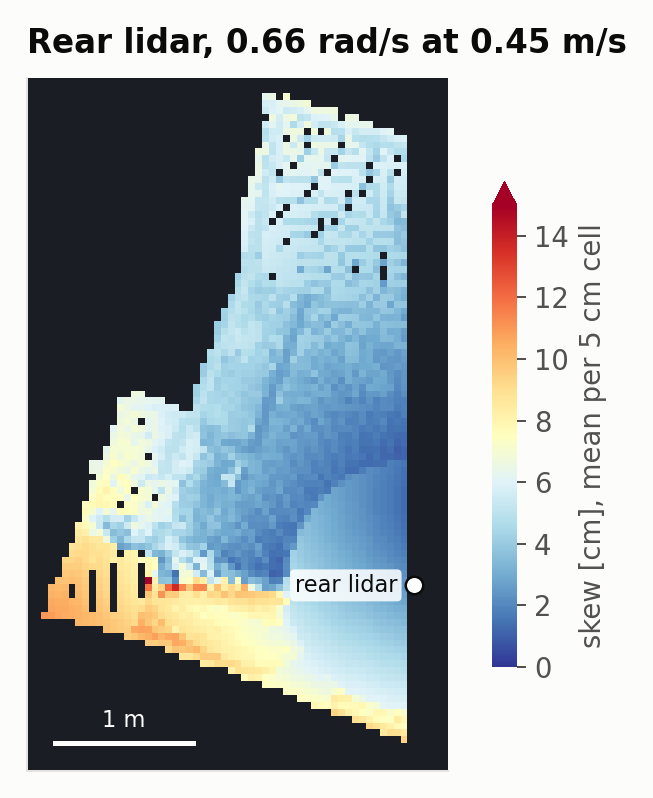
Raw skew on the rig's rear lidar at its sharpest turn, top view.
Get started
- Install: apt packages with CUDA built in, or build from source, then a first launch
- Configuration: every parameter, filters, IMU deskewing, bag playback
- Pipeline: what polka replaces, the internal stages, the file layout
- Architecture: the CPU and CUDA merge engines, filters, source adapters, threading
- Deskew: how big skew gets, and what deskew fixes on public KITTI data
- Performance: deskew cost against GLIM, rko_lio and LIO-SAM, the CPU/CUDA crossover, bandwidth
License and credits
Apache-2.0. The per-point deskewing motion model is inspired by rko_lio (Malladi et al., 2025, arXiv:2509.06593).